The Social Ecology of John Steinbeck and the Birth of The Discovery Process™
Mack and the Boys as Consultants:
The Contributions of John Steinbeck to Social Action Theory
"A Meeting of Minds on Cannery Row: Steinbeck
Now makes the connection between the writings of John Steinbeck and the theory of Social Ecology"
- "Was John Steinbeck the First Social Ecologist?"
- "A Meeting of Minds on Cannery Row: John Steinbeck's Phalanx, Carl Jung's Types, and James Kent's Gathering Place Roles"
- "Lessons from Doc's Lab: Cannery Row's Mack and the Boys as Consultants"
JKA begins Social Ecology Program with IRWA!
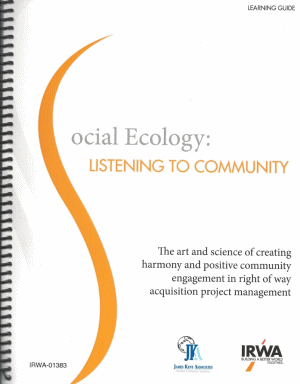 JKA and the International Right of Way Association deepened our partnership over the last few months to launch a Social Ecology program within the 10,000 member professional organization. After 4 years, 20 columns for their magazine, and 4 conferences seminars, we have begun a training program that will take us around the country in the coming months.
Here is how IRWA introduced the course to its members:
Introducing IRWA Course 225:
Social Ecology - Listening to Community
Techniques for creating harmony and positive community engagement in right of way acquisition project management
The pilot training session was held in Pablo, Montana in November, 2013. The January edition of 2014 of International Right of Way magazine summarizes that experience:
JKA's Regular Column in Right of Way Magazine
Jim Kent is a columnist for the Right of Way Magazine for the International Right of Way Association. What does it say when a 75-year old, well-established engineering magazine, dedicated to the technical aspects of energy site and corridor development, invited a regular column from Jim on Social Ecology, the Science of Community? Jim shares cutting edge insights, learning experiences and solutions. Read more»»
- "Social Ecology: A Special Collection of Articles on the Art and Science of Social Ecology", Jointly published by the International Right of Way Association and James Kent Associates, 2016
- IRWA #50 Nov/Dec, 2022 "Reconnecting Communities "
- IRWA #49 Mar/Apr. 2022 "Listening to Community: Key Steps for Success with IIJA"
- IRWA #48 Nov/Dec, 2021 "Infrastructure Projects: Using the social ecology process in adjusting to new project reality"
- IRWA #47 May/Jun, 2021 "Enter the Bridger: Participation partnerships can be “found” in translation"
- IRWA #46 Mar/Apr, 2021 "Understanding Citizen’s New Empowerment"
- IRWA #45 Jan/Feb, 2021 "Blast From The Past: Looking At The Last Five Years"
- IRWA #44 Nov/Dec, 2020 "Due Diligence, New Diligence"
- IRWA #43 Sep/Oct, 2020 "A Future in Motion"
- IRWA #42 Jul/Aug, 2020 "Old Ideas About Community Engagement"
- IRWA #41 May/June, 2020 "Celebrating the 11th Anniversary of the Social Ecology Column"
- IRWA #40 May/Jun, 2020 "Myths and Assumptions"
- IRWA #39 Mar/Apr, 2020 "Restructure Your Organization"
- IRWA #38 Jan/Feb, 2020 "Avoiding the Great Divide, Part 2"
- IRWA #37 Nov/Dec, 2019 "Avoiding the Great Divide, Part 1"
- IRWA #36 May/June, 2019 "Examining the Roadblocks"
- IRWA #35 Mar/Apr, 2019 "Citizens Awakening - The Paradigm Shift"
- IRWA #34 Jan/Feb, 2019 "The Oatmeal Circuit"
- IRWA #33 Nov/Dec, 2018 "Social Risk Scoring"
- IRWA #32 Jul/Aug. 2018 "Successful Project Implementation"
Expanding the Operating Space of the Right of Way Professional Social Ecology - IRWA #31 May/Jun, 2018 "Predict Community Push Back"
- IRWA #30 Mar/Apr, 2018 "Managing Project Complexity"
- IRWA #29 Jan/Feb, 2018 "The Power of Community Engagement"
- IRWA #28 Nov/Dec, 2016 "Defending Sacred Land - The Power of Cultural Attachment"
- IRWA #27 Sept/Oct, 2016 "Geographic Democracy - A widespread power shift changing project outcomes"
- IRWA #26 May/June, 2016 "Mitigating the Fear"
- IRWA #25 March/April, 2016 "Stopping NIMBYism in its Tracks"
- IRWA #24 Workbook for Course #225, Social Risk Management for the Infrastructure Professional, A Manual for Best Practices in Community Engagement
- IRWA #23 Nov/Dec, 2014 A Fresh Perspective - Course field trip reveals impact on local community
- IRWA #22 January/February, 2015 "Preventing a Chain Reaction: Understanding Social Risk as it Relates to Infrastructure Projects"
- IRWA #21 May/June, 2014 "Community Impact from a Global Perspective: Keeping Social Risk Assessments Close at Hand"
- IRWA #20 Jan/Feb, 2014 "The People Factor"
- IRWA #20A Jan/Feb, 2014 "Birth of a New Course"
- IRWA #19 Nov/Dec, 2013 "A Grassroots Campaign"
- IRWA #18 Sept/Oct, 2013 "A Tale of Two Mines"
- IRWA #17 July/Aug, 2013 "Surging Industries in Global Energy"
- IRWA #16 Jan/Feb, 2013 "The Social Risk - When Citizens Organize to Fight a Project"
- IRWA #15 July/Aug, 2012 "Saving Fast Track: Alternative Energy Futures at Stake"
- IRWA #14 May/June, 2012 "Working Constructively with Concerned Citizens"
- IRWA #13 Jan/Feb, 2012 "The Promise and Peril of Corridor Expansion"
- IRWA #12 May/June, 2011 "Relocating the Marine Corps"
- IRWA #11 Jan/Feb, 2011 "Streamline Your Next Project: The Case for Goodwill"
- IRWA #10 Nov/Dec, 2010 "Human Geographic Mapping: A New Approach"
- IRWA #9 Sept/Oct, 2010 "The BP Disaster and Lessons Learned"
- IRWA #8 July/Aug, 2010 "Collaboration under the NEPA Umbrella"
- IRWA #7 May/June, 2010 "When Ignorance is not Bliss"
- IRWA #6 March/April, 2010 "Overcoming Community Roadblocks"
- IRWA #5 Jan/Feb, 2010 "Inside the Invisible Community"
- IRWA #4 Nov/Dec, 2009 "Perception of the Local Language"
- IRWA #3 Sept/Oct, 2009 "Leveraging the Science of Community"
- IRWA #2 July/Aug, 2009 "The Holy Cross Energy Experience"
- IRWA #1 May/June, 2009 "Wind Energy Development and Public Perception"
Cobalt Web Designs